Showing posts with label Animal Cell. Show all posts

Monday, 17 February 2014

Cell membranes and transport


Diffusion= Movement of molecules from a region of high to low concentration. It is a passive process. Determinants:

  1. Steepness of the concentration gradient 
  2. Temperature
  3. Surface Area
  4. Distance/Thickness of membrane
  5. Size of molecule 
Facilitated diffusion= Diffusion with the help of protein molecules (transports water and glucose

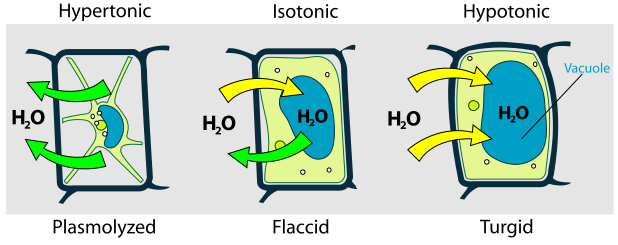
Osmosis= The net movement of water from a region of high to low water potential through a partially permeable membrane. (Pure water has a water potential of 0 any addition of solute lowers)

Active transport= Uses ATP to move substances against their concentration gradient, (conducted by carrier proteins)

Endocytosis= A section of the plasma membrane surrounds a large object and then "pinches" off to form a vesicle (Bulk transfer of materials into the cell)

Exocytosis= Transported substances are carried in vesicles to the cell membrane where they are released after fusion with the plasma membrane

The effect of water potential on cells

Animal:

Plant:

Wednesday, 15 January 2014

Cell Structure

Animal Cell Structure:

Functions:

Nucleus= Contains DNA coding for proteins (DNA+histone proteins=chromatin).

Nucleolus= Involved in the production of ribosomes.

Nuclear Envelope= Allows exchange between the cytoplasm and nucleus (e.g mRNA).

Rough Endoplasmic Reticulum (RER)= Processes proteins and packages into vesicles.

Smooth Endoplasmic Reticulum (SER)= Production of lipids,cholesterol and steroid hormones.

Golgi Apparatus= Collects products from the ER (in vesicles) processes and packages.

Ribosomes= Site of protein synthesis from mRNA.

Mitochondria= Involved in the final stages of aerobic respiration to produce ATP.

Lysosomes= Contains digestive/hydrolytic enzymes which digest macromolecules.

Plasma membrane= Allows for a unique environment within the cell (By controlling flow).

Centrioles= 2 found just outside the nucleus at 90° of each other. Involved in nuclear division.

Flagella and Cillia= made out of microtubules. Involved in movement.

Cytoskeleton= Involved in transport of vesicles.

Plant Cell Structure:

Functions:

Does not contain centrioles

Chloroplasts= produces glucose by absorbing light energy (photosynthesis)